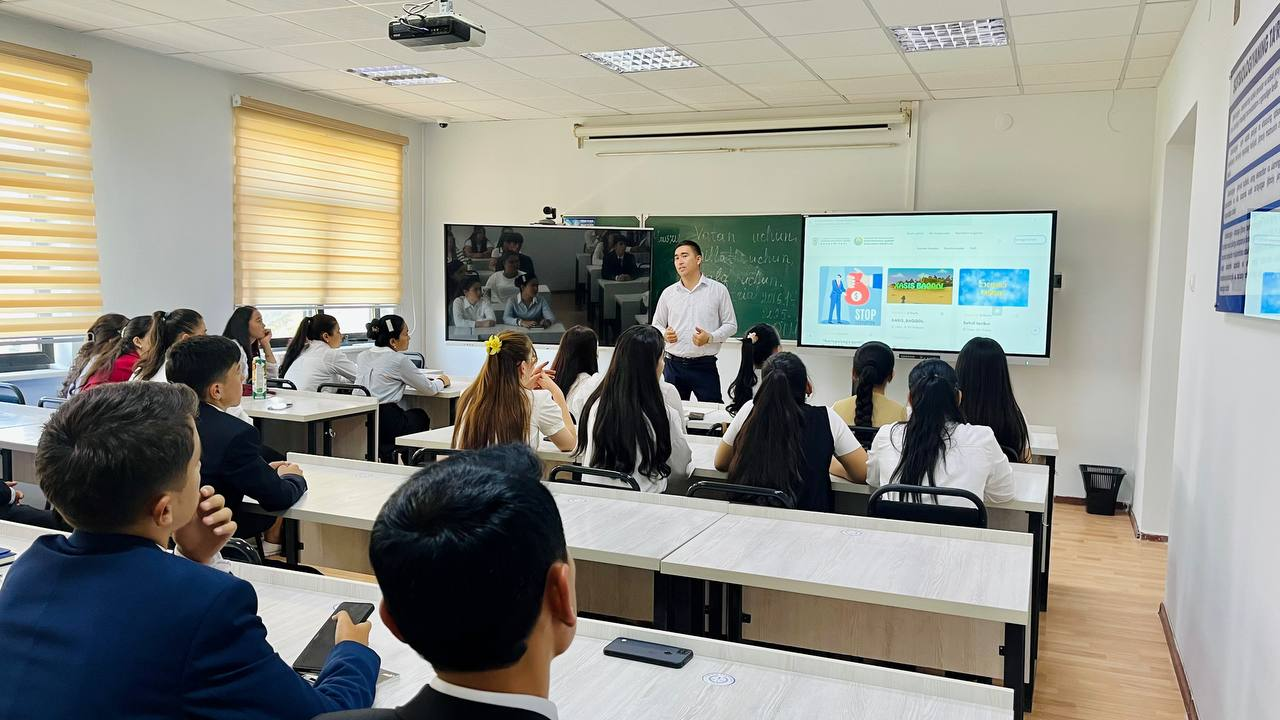
Termez State University (TerSU) integrates sustainable development education across its academic provision through common environmental education, degree-specific teaching and an institution-wide educational programme. This approach equips students across disciplines with knowledge of environmental stewardship, inclusive development, responsible resource use, peace and institutional responsibility.
Sustainability education across all academic fields
Sustainable development is an institutional educational priority at TerSU. The university incorporates SDG principles into teaching across its fields of study, connecting environmental, social, economic and governance challenges with students’ future professions. Two cross-disciplinary subjects form part of this university-wide approach: “Ecology and Environmental Protection” and “Environmental Protection and Green Development.”
|
Cross-disciplinary subject |
Educational content |
SDG relevance |
|
Ecology and Environmental Protection |
Environmental systems, conservation, pollution prevention, biodiversity and responsible use of natural resources |
6, 13, 15 |
|
Environmental Protection and Green Development |
Green development, environmental responsibility, resource efficiency and sustainable decision-making |
4, 7, 12, 13, 15 |
Subject-specific learning across academic disciplines
The university extends SDG learning through specialist subjects in natural sciences, economics, law, technology, social work and tourism. The examples below demonstrate the connection between sustainability education and field-specific learning.
|
Academic field |
Subjects included in the academic catalogue |
Relevant SDGs |
|
Economics and finance |
Green Economy; Sustainable Finance; Environmental Economics and Climate Change |
8, 12, 13 |
|
Biology and ecology |
Biodiversity; Climate Change and Ecological Adaptation; Ecology and Environmental Protection |
13, 15 |
|
Chemistry |
Green Chemistry; Environmental Management and Audit |
12, 15 |
|
Energy and physics |
Photovoltaic Power Stations and Systems; Energy Resource Physics |
7, 13 |
|
Law and governance |
Anti-Corruption and Compliance Control |
16 |
|
Education and social work |
Inclusive Education; Social Work with Different Population Groups |
4, 10 |
|
Tourism |
Sustainable Tourism Development |
8, 11, 12 |
University-wide 10-hour course delivered in 2025
In December 2025, TerSU delivered the special course “New Uzbekistan: Sustainable Development, Peace and International Recognition of Islamic Enlightenment” for all undergraduate fields and master’s specialisations. The 10-hour programme followed an instruction from the Ministry of Higher Education, Science and Innovation of Uzbekistan. Its curriculum and study guide were prepared by the International Islamic Academy of Uzbekistan, with teaching provided by qualified academics from TerSU’s Faculties of Law and History.
|
Programme feature |
|
|
Duration |
10 academic hours |
|
Academic coverage |
All undergraduate fields and master’s specialisations |
|
Learning themes |
Sustainable development, peace, international relations and civic awareness |
|
Teaching units |
Faculties of Law and History |
|
Teaching framework |
Programme and study guide developed by the International Islamic Academy of Uzbekistan |
4. Academic infrastructure supporting integration
TerSU’s HEMIS inventory maps academic provision across 11 faculties and 42 departments, with 1,769 departmental subject entries and 2,933 subject-to-programme placements. The catalogue supports institution-wide coordination of common and specialist sustainability teaching.
5. Contribution to the SDGs
TerSU’s university-wide model combines shared sustainability foundations, specialised disciplinary knowledge and a common 2025 learning programme. Together, these components support SDG Target 4.7 and prepare students to apply the SDGs in professional practice, public service, environmental management, economic development and community life